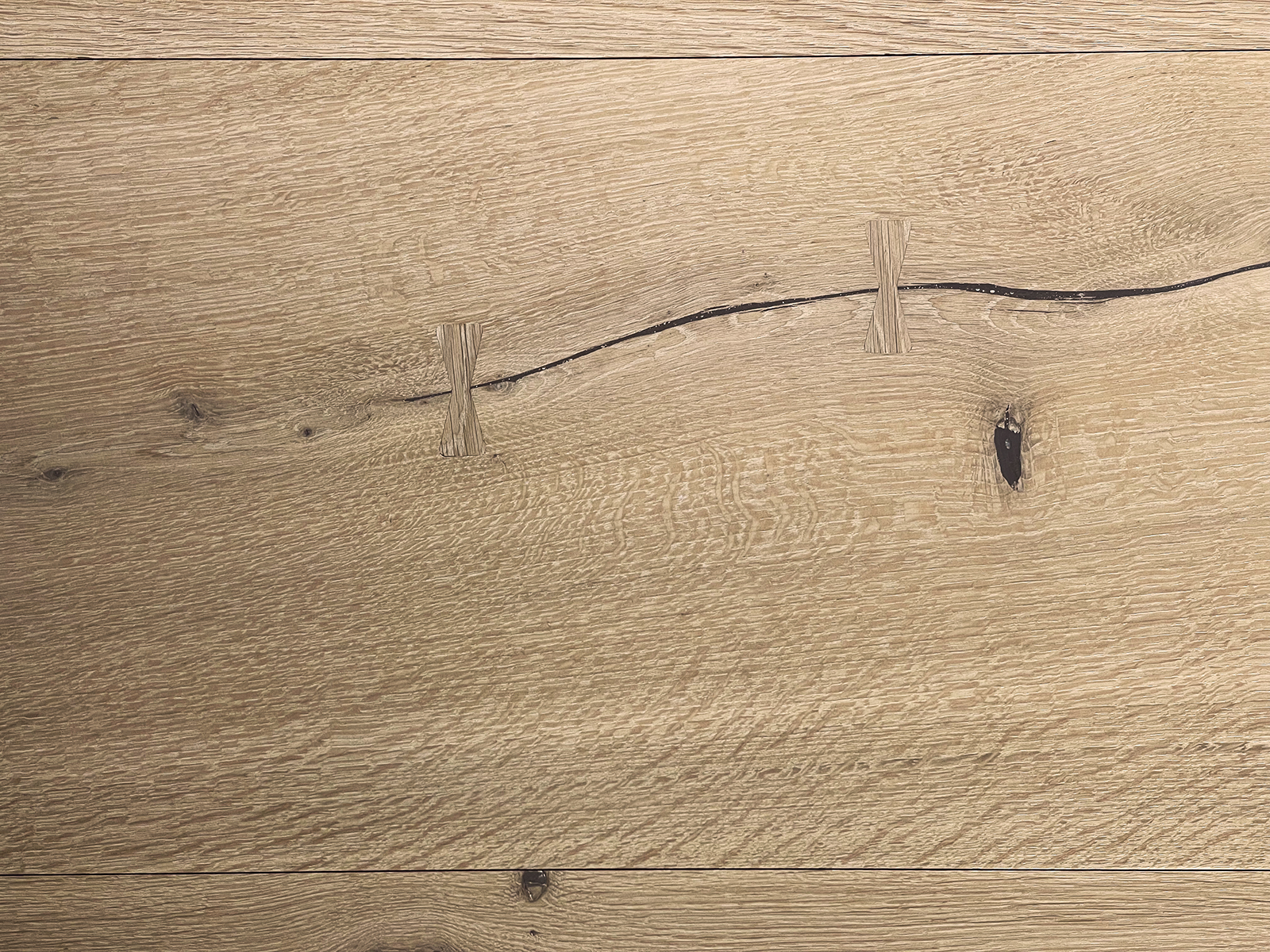
Photo: Dinesen white oak floor with butterfly joints, which hold splits together instead of wasting the board.
01Why wood
How good is wood?
Wood is renewable, non-toxic, biodegradable and recyclable, and it stores carbon for as long as it is in use. As a rule of thumb, a cubic metre of wood holds the equivalent of about one tonne of CO₂. 86% of the 84 wood grades in the database are tagged Renewable, and the median footprint is 0.4 kg CO₂e/kg.
But felling a tree is not free. Only around a quarter of a harvested tree becomes sawn wood or engineered products; the rest is left to decompose or burned. Research published in Nature in 2023 argues that this harvest burden can outweigh the benefits unless the wood goes into long-lasting products, used efficiently. That is the thread through this deep dive: the new technologies matter because they get more value, and more years, out of every tree.
Where wood's carbon comes from
Around three-quarters of the footprint of sawn wood comes from drying, so the energy a sawmill runs on decides most of the number. Kiln-dried softwood ranges from about 0.05 kg CO₂e/kg in mills running on renewable or bio-energy to 0.5 in mills that depend on fossil fuels. The database gives kiln-dried spruce a typical 0.19 kg CO₂e/kg.
Compared with plastics and metals the gap is large. Ash is 0.39 kg CO₂e/kg, against 2.3 kg CO₂e/kg for PVC, 2.1 kg CO₂e/kg for mild steel and 10.6 kg CO₂e/kg for primary aluminium. Per kilo is only a starting point, though: compare parts that do the same job, and include how long each will last.
Carbon footprint, raw material to factory gate (kg CO2e per kg)
Species, softwoods and hardwoods
Softwood and hardwood are botanical labels, not hardness ratings. Softwoods come from conifers and make up most construction timber and engineered wood; of spruce, pine, hemlock, larch and Douglas fir, only larch is durable enough to use outdoors untreated. Hardwoods such as birch, beech, ash and oak tend to grow slower and denser, and each has its own use.
Tropical hardwoods are the most prized and the most overexploited; many are now vulnerable or endangered. The map below sorts the 32 wood families in the database by typical carbon.
Typical carbon by family (kg CO₂e/kg; number of grades in brackets)
Each family opens in the material checker.
02Engineered and laminated timber
Mass timber: CLT, glulam and LVL
Laminating is how small, fast-grown trees become large, stable structural members. Glulam bonds boards with their grain parallel into beams and columns. LVL (laminated veneer lumber) bonds thin peeled veneers into very strong, straight sections. CLT (cross-laminated timber) stacks boards in alternating directions into wall and floor panels that can replace concrete slabs.
All three sit close to sawn timber on carbon: glulam is 0.4 kg CO₂e/kg, LVL 0.4 kg CO₂e/kg and CLT 0.34 kg CO₂e/kg, against 0.16 kg CO₂e/kg for high-strength concrete per kilo, and concrete needs far more kilos. The adhesive is the part to check: most European CLT uses polyurethane glue, and some glulam and LVL still uses formaldehyde-based resins.
Europe leads the market: Austria and Germany make most of the world's CLT, and capacity is expanding in Central Europe and North America. The constraint is less the wood than the presses, the fire engineering and the designers who know how to use it.
Engineered timber compared (kg CO2e per kg)
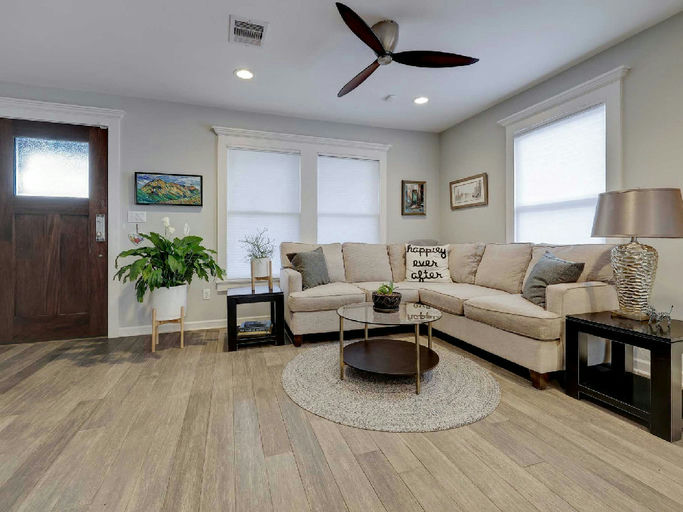 HempWood 3-Layer cross-laminated hemp panel by FibonacciFibonacciThe HempWood 3-Layer Panel is a cross-laminated board made from three layers of solid HempWood by Fibonacci LLC in Murray, Kentucky, USA.Image: Fibonacci
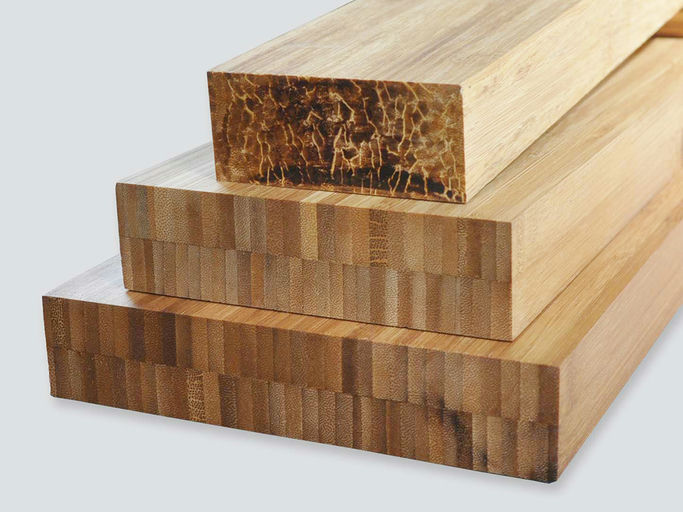 Plyboo engineered wood panels by Smith and FongSmith & FongPlyboo engineered wood panels by Smith and Fong use bamboo in place of wood, bonded with ultra-low emitting formaldehyde (ULEF) adhesive. Bamboo grows with little to no fertilisers, pesticides or irrigation. It is FSC (Forest Stewardship Council) certified and provides a sustainable alternative to wood.Image: Smith & Fong
Sources: Persistence Market Research, mass timber 2026 · Expert Market Research, Europe CLT
Boards and glues: plywood, OSB, particleboard and MDF
Boards turn offcuts, thinnings and sawdust into flat, stable sheet, which is the most efficient use of a tree. OSB is 0.4 kg CO₂e/kg, particleboard 0.4 kg CO₂e/kg and MDF 0.65 kg CO₂e/kg: more processing, pressing and glue than solid timber, but from wood that would otherwise be burned.
The glue is the catch. Formaldehyde, classed as a carcinogen by the WHO, binds most boards; most of its off-gassing happens in the first months, but dense boards like MDF can emit for years. Look for no added formaldehyde (NAF) or ultra-low-emitting (ULEF) boards indoors: the NAF version of MDF is 0.72 kg CO₂e/kg, slightly more carbon for much cleaner air. The EU now limits formaldehyde emissions from wood-based articles under REACH.
The new direction is bio-based binders: soy-based glues in plywood, rapeseed-protein resins in MDF, and lignin, wood's own glue, replacing fossil phenol in resins for plywood, OSB and LVL. Stora Enso claims its lignin cuts the resin's footprint by up to 80%.
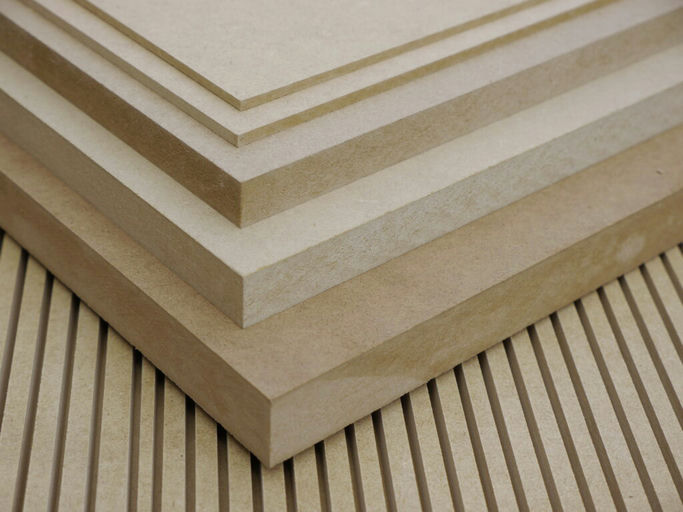 Evertree Next medium density fibreboard (MDF)EvertreeEvertree Next medium density fibreboard (MDF) is bonded with Evertree's 100% bio-based resin, made from the protein-rich oil-cake left after rapeseed and sunflower seeds are crushed for oil. It contains no added formaldehyde (NAF) or isocyanate, and Evertree says its emissions are the same as natural wood.Image: Evertree
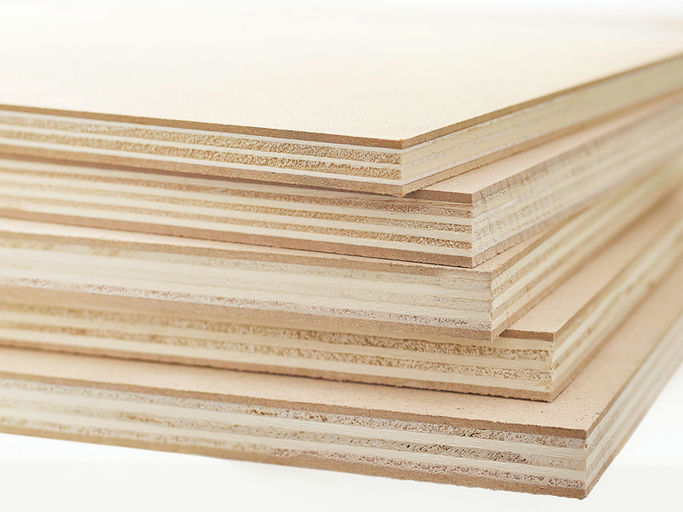 Pureglue plywoodPanguanetaPureglue plywood manufactured by Panguaneta is produced with no added formaldehyde (NAF). It is made from poplar veneers, mainly from Panguaneta's own plantations in Italy, bonded with Soyad, a soy flour adhesive with a cross-linking resin developed with Solenis.Image: Panguaneta
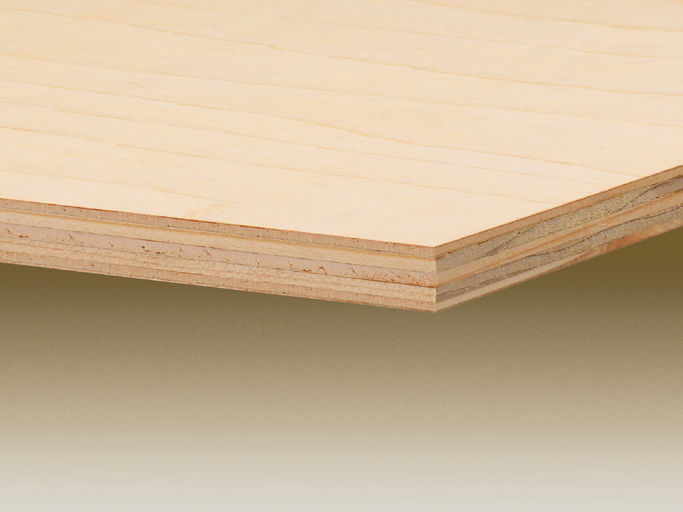 SoyStrongStates IndustriesSoyStrong products by States Industries are made with no added formaldehyde (NAF) - they use soy-based binders in the production of their hardwood plywood (HWPW) panels. States Industries is FSC certified and its panels meet the ANSI/HPVA HP-1 standard and CARB 93120 formaldehyde rules.Image: States Industries
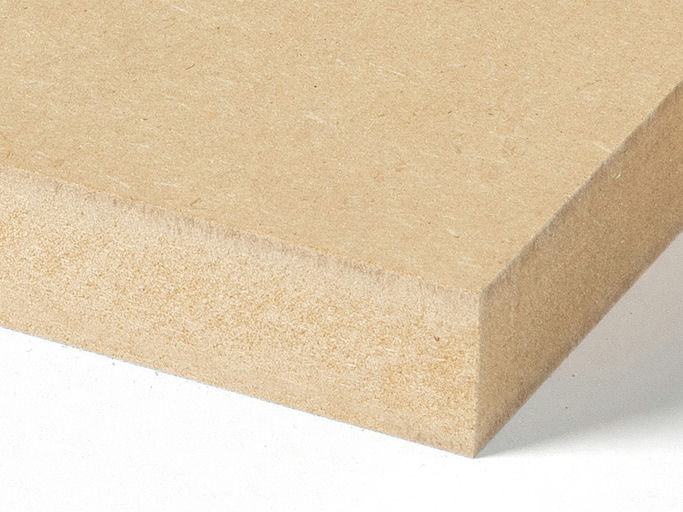 Fibralux NAF medium density fibreboard (MDF)UnilinFibralux NAF medium density fibreboard (MDF) produced by Unilin is made with recycled fibres (including MDF panels) and uses no added formaldehyde (NAF) adhesive. It is approved by the Californian Air Resources Board as an NAF board and is available FSC or PEFC certified on request.Image: Unilin
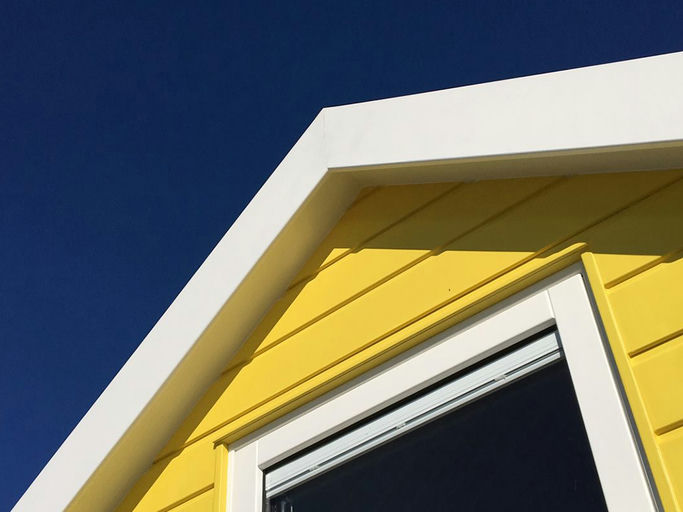 Medite Tricoya Extreme medium density fibreboard (MDF)MEDITE SMARTPLYMedite Tricoya Extreme is a medium density fibreboard (MDF) by Roseburg with no added formaldehyde (NAF) in combination with acetylated wood fibre. This means the wood is treated with acetic anhydride, resulting in a harder, more dimensionally stable and insect resistant composite.Image: MEDITE SMARTPLY
03Fibre and new wood technologies
Wood fibre: insulation, moulded fibre and composites
Separate wood into fibres and it becomes a very different material. Wood fibre insulation (1.13 kg CO₂e/kg) is breathable, buffers moisture and stores heat, so it competes with mineral wool and foam in roofs and walls; most boards still use a few per cent of PUR binder.
Formed or moulded fibre presses pulp into trays, bowls, lids and protective packaging. Moulded pulp is 1.29 kg CO₂e/kg. Dry-forming processes such as PulPac's use far less water and energy than wet moulding, and producers like Stora Enso are adding capacity to replace plastic in food service.
Wood-fibre composites blend fibre with plastic or bioplastic so it can be injection moulded: PP with 30% wood flour is 1.6 kg CO₂e/kg against 1.85 kg CO₂e/kg for plain PP. Stora Enso's DuraSense, for example, claims to cut the plastic in a product by up to 60%. The trade-off is end of life: a blend is harder to recycle than either material on its own.
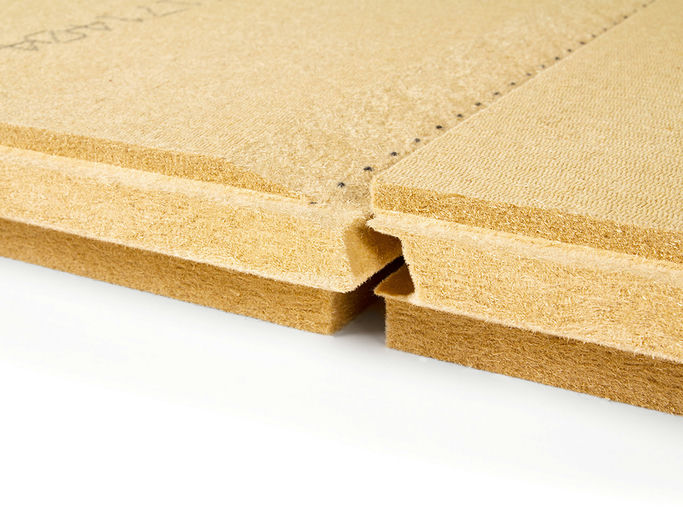 Gutex wood fibre insulationGutexFibre insulation panels and loose fill produced from wood provide a sustainable alternative to synthetic materials for thermal and acoustic applications in walls, ceilings and roofs. The panels are breathable and recyclable.Image: Gutex
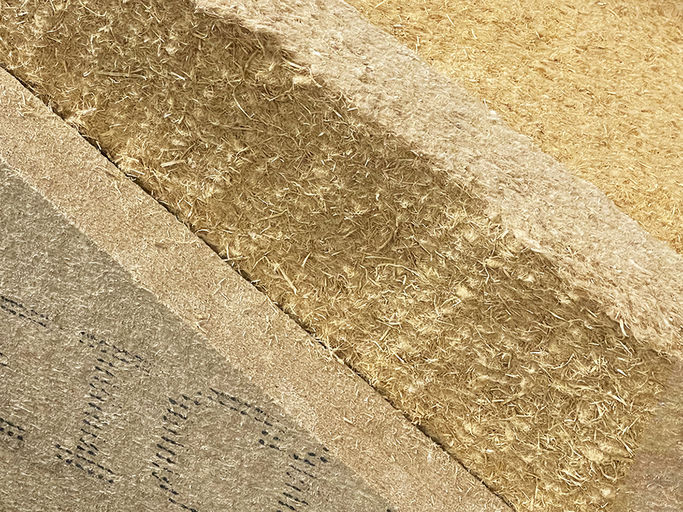 Steico wood fibre insulationSteicoFibre insulation panels and loose fill produced from wood provide a sustainable alternative to synthetic materials for thermal and acoustic applications in walls, ceilings and roofs. The panels are breathable and recyclable.Image: Steico
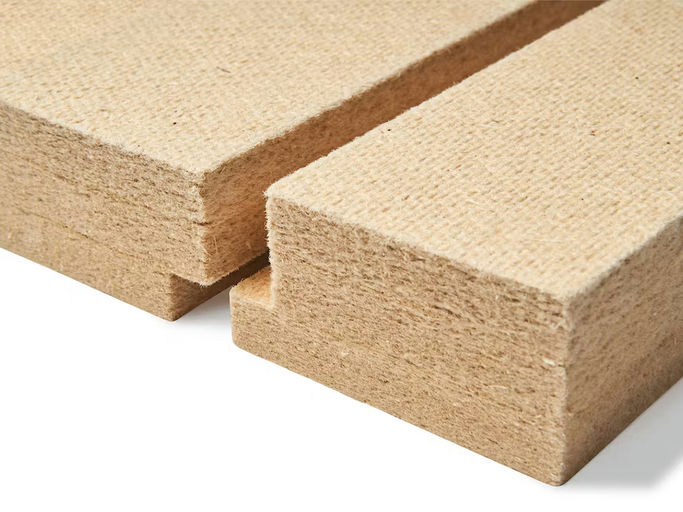 Hunton wood fibre insulationHuntonFibre insulation panels and loose fill produced from wood provide a sustainable alternative to synthetic materials for thermal and acoustic applications in walls, ceilings and roofs. The panels are breathable.Image: Hunton
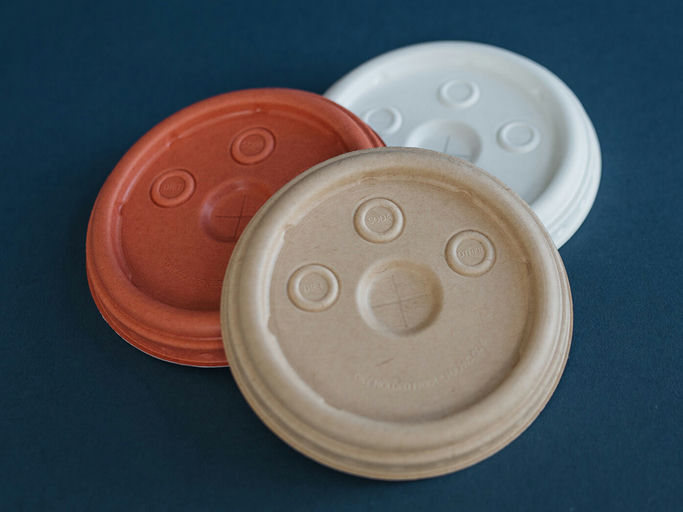 Dry molded fiber by PulpacPulPacThe dry molded fiber process, developed by Pulpac, removes most of the water from paper pulp moulding, which helps to increase efficiency, reduce cycle time, and minimise carbon footprint.Image: PulPac
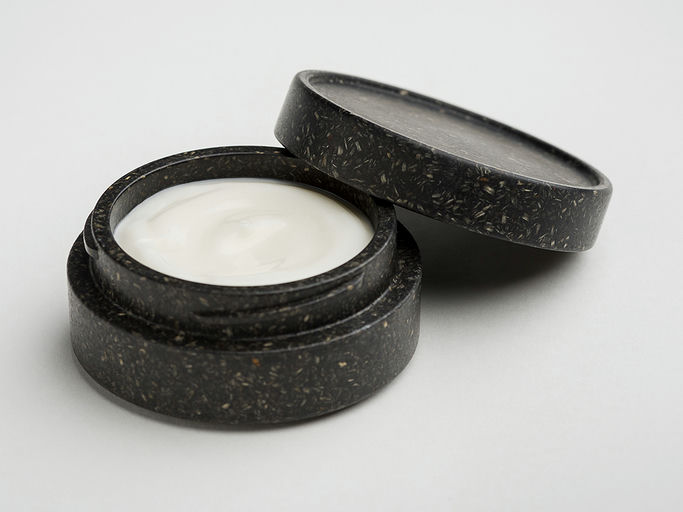 Sulapac bioplastic packagingSulapacSulapac bio-based packaging includes a range of bioplastics and bio-based composite solutions for injection moulded and thermoformed packaging, as well as 3D printing.Image: Sulapac
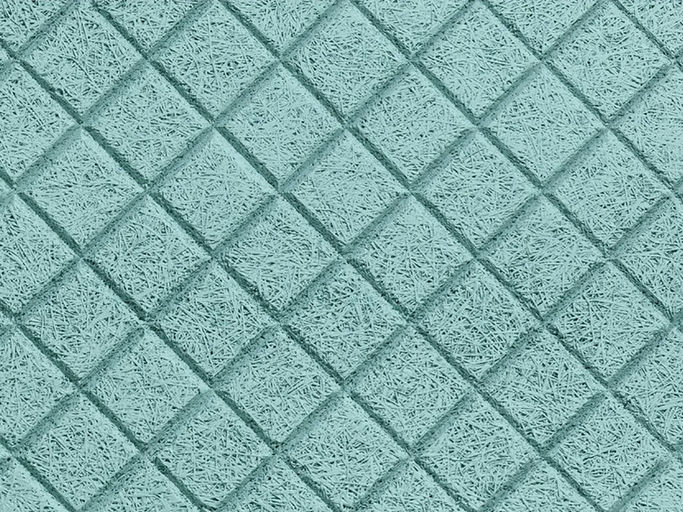 Baux acoustic wood wool cement boardBauxBaux acoustic wood wool cement board made from wood wool, cement and water. While it has very good acoustic properties for ceiling and walls, it also helps regulate indoor temperature and humidity by absorbing and releasing moisture.Image: Baux
Sources: Stora Enso PureFiber (Packaging News) · Stora Enso DuraSense (Packaging Europe)
Modified and densified wood
Modification makes fast-grown softwoods and hardwoods last outdoors without toxic preservatives, which takes pressure off tropical timbers. Thermal modification heats wood to 180–230 °C in a controlled atmosphere, cooking off the sugars that fungi feed on (thermally modified pine is 0.85 kg CO₂e/kg). Acetylation changes the wood's chemistry so it barely absorbs water (Accoya is 0.8 kg CO₂e/kg); furfurylation polymerises a bio-based liquid inside the cells (Kebony is 0.7 kg CO₂e/kg). Yakisugi, the Japanese technique of charring the surface, does a similar job with fire.
Modification adds energy, so the footprint is several times that of plain sawn softwood, but it can replace tropical hardwood, composite decking or treated wood that would need replacing much sooner.
Densified wood goes further. InventWood (USA) partly removes lignin and hemicellulose and then compresses the wood, which it says gives a strength-to-weight ratio around ten times that of steel. It began shipping its first commercial batches, for facades and interiors, in October 2025. Not to be confused with the Danish Superwood cladding in Spotlight, which is CO₂-impregnated spruce.
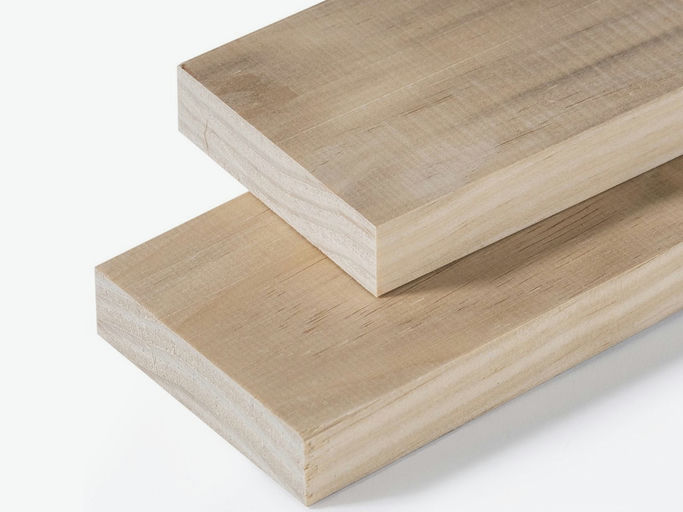 Accoya acetylated woodAccsysAccoya wood is modified radiata pine. Through a process of acetylation, the chemical structure of the wood is altered, resulting in a dimensionally stable and extremely durable timber guaranteed for 50 years above ground and 25 years in ground or freshwater. The process does not add any toxins to the environment.Image: Accsys
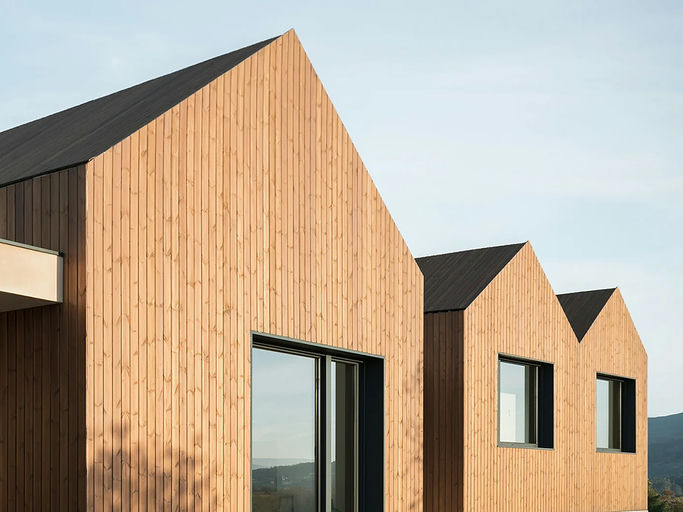 Lunawood Thermowood thermally modified timberLunawoodLunawood Thermowood thermally modified timber (TMT) includes a range of wood types that have been physically and chemically modified with heat. Durability is increased and biological resistance to pests and microorganisms is enhanced, without the use of chemical preservatives and insecticides.Image: Lunawood
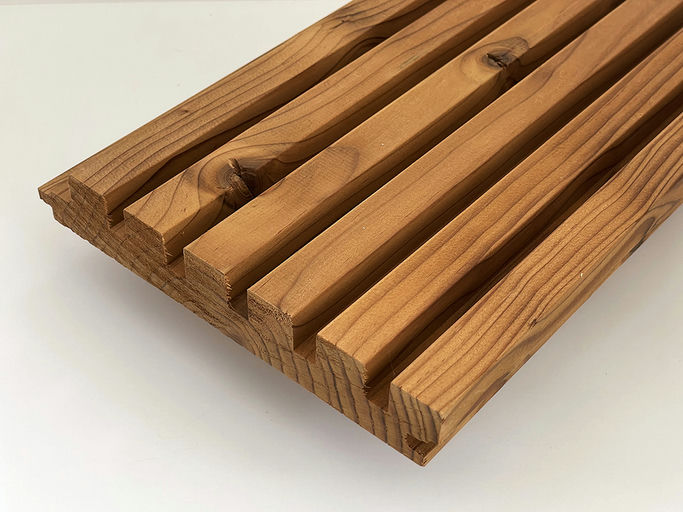 Thermory thermowood thermally modified timber (TMT)ThermoryThermory thermowood thermally modified timber (TMT) includes a range of wood types that have been physically and chemically modified with heat (160-215 degC), with no chemicals used in the process or the final product.Image: Thermory
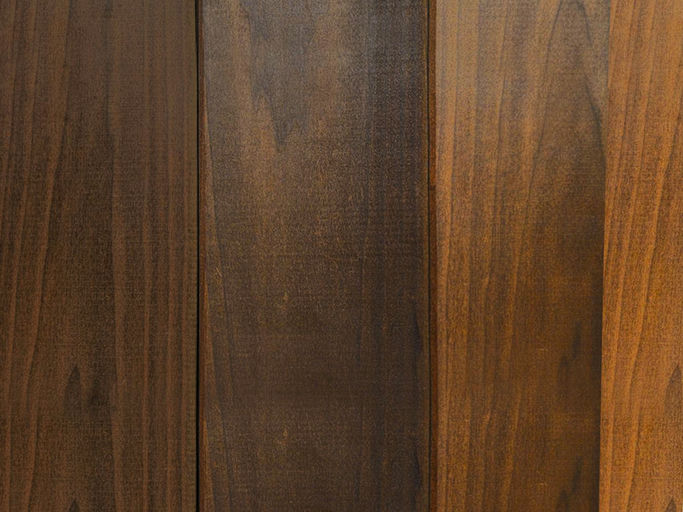 Cambia thermally modified woodCambia (Northland Forest Products)Cambia thermally modified timber (TMT) includes a range of wood types that have been physically and chemically modified with heat. Durability is increased and biological resistance to pests and microorganisms is enhanced, without the use of chemical preservatives and insecticides.Image: Cambia (Northland Forest Products)Thermally modified ash, pine and red oak by Arbor Wood Co.Arbor Wood Co.Arbor Wood Co., based in Duluth, Minnesota, sells thermally modified ash, pine and red oak as cladding, decking, soffits and dimensional lumber.Superwood CO2-impregnated spruce cladding by SuperwoodSuperwoodSuperwood is Finnish spruce cladding and exterior timber treated in Denmark by a process that uses supercritical carbon dioxide at up to 150 bar to carry a protective agent deep into the wood, without water or heavy metals and with about one gram of agent per board.
Sources: Engineering (2026): Superwood · TechCrunch
From pulp to new materials
Dissolve wood further and you reach the building blocks. Lyocell spins dissolved wood pulp into textile fibre in a closed solvent loop (lyocell is 3.75 kg CO₂e/kg). Microfibrillated cellulose (1 kg CO₂e/kg) strengthens paper, coatings and composites, while nanocellulose (4.2 kg CO₂e/kg) is stronger still but energy-hungry to make. Lignin, long burned at pulp mills, now becomes bioplastic, such as Arboform liquid wood at 1 kg CO₂e/kg, resin binders and carbon-fibre precursors.
These are wood's highest-value uses per tonne, and the most likely to keep growing.
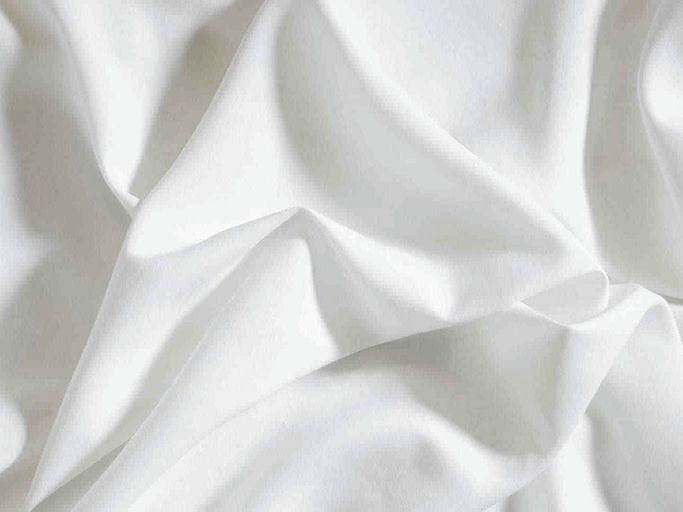 Tencel LyocellLenzingTencel Lyocell by Lenzing is a type of regenerated cellulose fibre, derived from wood pulp. The conventional way of making this type of fibre uses large amounts of hazardous chemicals.Image: Lenzing
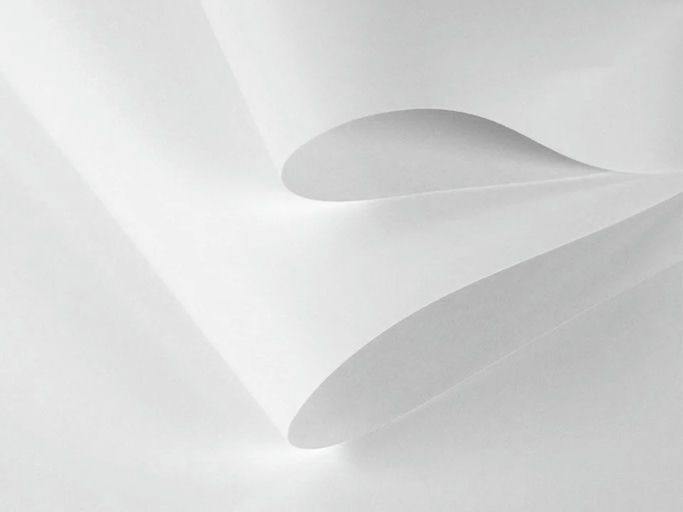 Celova micro fibrillated cellulose (MFC) and cellulose powder by WeidmannWeidmannCelova micro fibrillated cellulose (MFC) and cellulose powder by Weidmann, made from pulp from FSC and PEFC managed forests in Europe, suitable for converting into paper, textile, barrier coatings, packaging, fibre composites and cement products, and also sold for cosmetics.Image: Weidmann
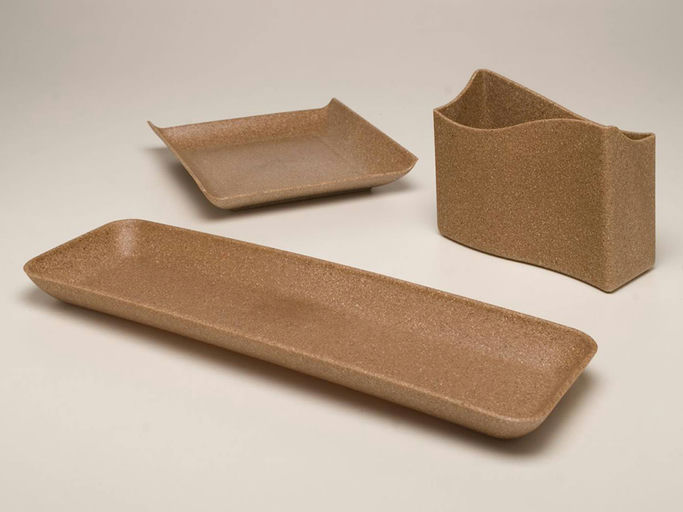 Arboform liquid wood lignin bioplasticTecnaroArboform by Tecnaro, also called liquid wood, is made up of around 30% lignosulfonate (LS) - a byproduct of papermaking - 60% fibre and around 10% polylactic acid (PLA) additives. While preparation is not quite the same as for conventional plastics, it can be injection moulded on regular thermoplastic forming machines.Image: Tecnaro
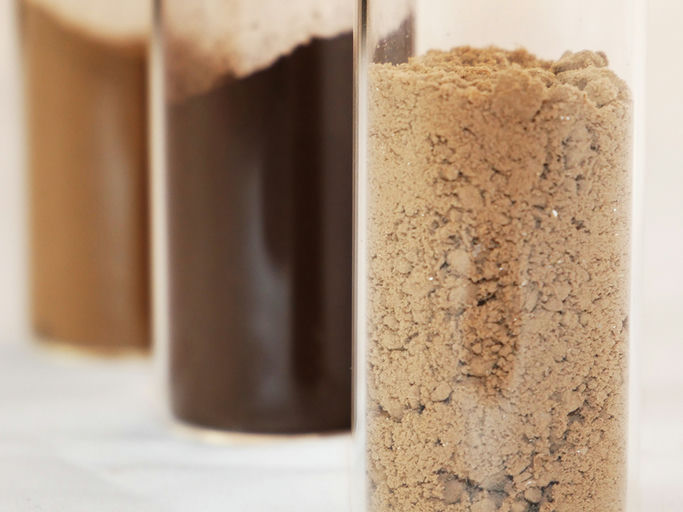 LignoPure lignin for bioplasticsLignoPure · In developmentLignoPure, a Hamburg start-up founded in 2019, produce sulphur-free lignin suitable as an ingredient in the production of bio-based plastics and composites. It is under development for a range of manufacturing processes like injection moulding, extrusion, melt spinning and 3D printing.Image: LignoPure
 Forest Film by UPM RaflatacUPM RaflatacForest Film labels by UPM Raflatac are made from wood-based raw materials. Crude tall oil, a by-product of the paper pulping process, is refined into UPM BioVerno naphtha, which is converted into bio-based polypropylene (bio-PP) and polyethylene (bio-PE, made by Dow), cutting out the use of fossil fuels.Image: UPM Raflatac
04Watch-outs
The warnings
Deforestation risk is tagged on 11 wood grades, so where the wood was cut matters as much as the species. Glues, finishes and treatments make 28 grades "potentially toxic in use". Carbon figures here run from forest to factory gate and leave out the carbon stored in the wood; counting it can push timber below zero, which is why published figures disagree.
Concerns tagged on wood grades (number of grades)
Out of 84 grades.
After use
Solid wood can be reused, recut, repaired and in the end composted or burned for energy: 79% of wood grades are tagged Biodegradable. Coatings, glues and preservatives are what close those doors. Design for disassembly, mechanical fixings and untreated or oiled surfaces keep timber in use longest.
Grades tagged with each end-of-life route, out of 84.
Rules and labels
Ask for FSC or PEFC certified supply. The EU Deforestation Regulation applies to large and medium operators from 30 December 2026 and to micro and small operators from 30 June 2027; until then the EU Timber Regulation still applies. These are the rules and labels most often linked to wood grades:
- Forest Stewardship Council (FSC)
- EU Deforestation Regulation (EU) 2023/1115
- Construction Products Regulation (EU) 2024/3110
- Programme for the Endorsement of Forest Certification (PEFC)
- Environmental Product Declaration (EN 15804 / ISO 14025)
- Food Contact Materials Regulation (EC) 1935/2004
- REACH: formaldehyde emissions from articles (Annex XVII entry 77)
- EU Toy Safety Regulation (EU) 2025/2509
Sources: Regulation (EU) 2025/2650 summary (AGRINFO) · QIMA
05Specifying
More from Spotlight
66 wood innovations are in Spotlight, from reclaimed urban timber to hemp and bamboo panels that look and work like wood.
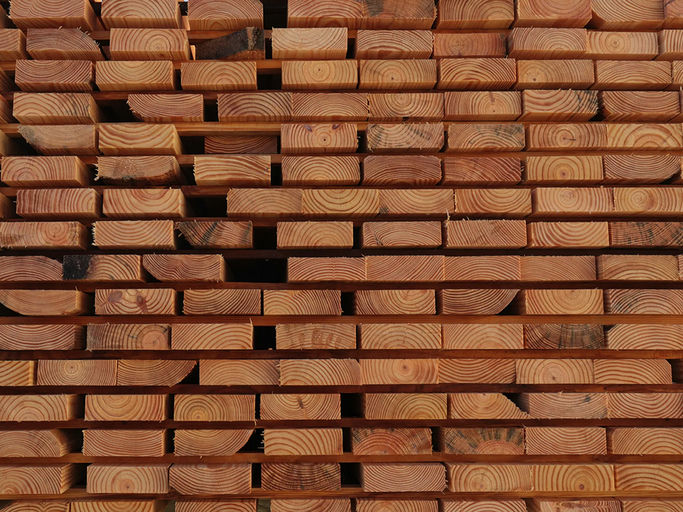 Carbon Smart Wood reclaimed urban timber by CambiumCambium CarbonCarbon Smart Wood is the product range of Cambium, a US company that saves wood from urban trees removed by tree services, from land clearing and from fire-mitigation work, wood that would otherwise be chipped, burned or sent to landfill.Image: Cambium Carbon
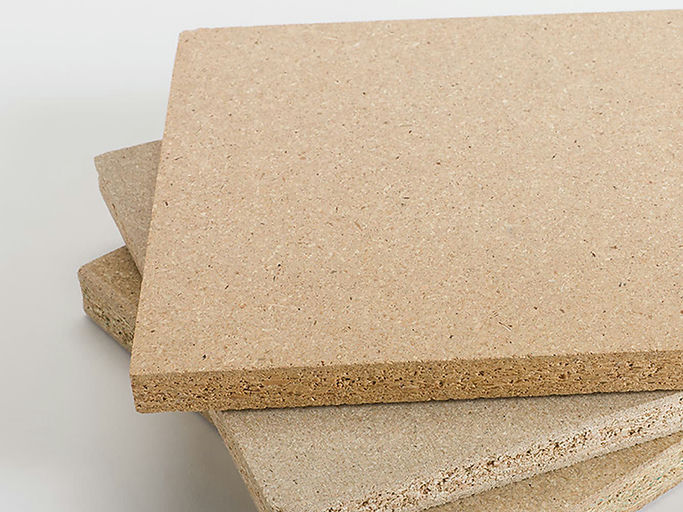 Vesta wood panelsAraucoVesta composite wood panels by Arauco are produced using an ultra low emitting formaldehyde (ULEF) adhesive and 100% recycled or recovered wood content (predominantly Douglas fir).Image: Arauco
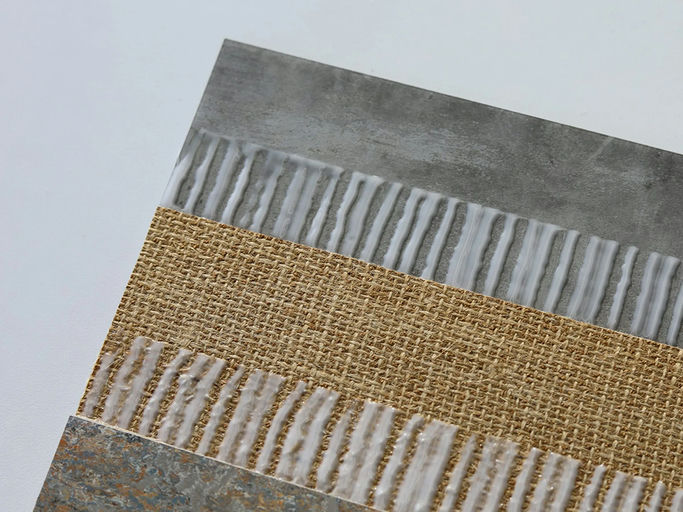 Corkment cork and linseed acoustic underlay by ForboForboCorkment is a 2 mm acoustic underlay from Forbo for its Marmoleum linoleum floors. It is made like linoleum: cork granules, oxidised linseed oil, resins and other ingredients are calendered onto a jute backing and cured.Image: Forbo
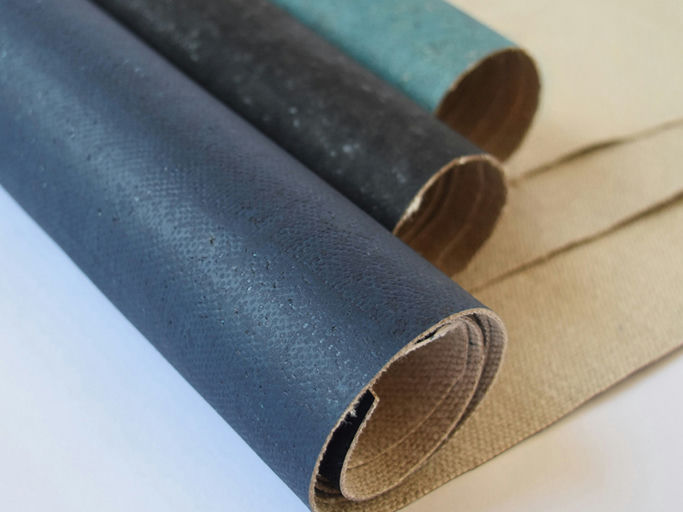 CORKonLINEN compostable cork and linen material by RTFACT BrandsRTFACT BrandsCORKonLINEN is a leather alternative from RTFACT Brands of Brest, France, made from just three ingredients: thin Portuguese cork, linen woven from flax grown in northern France, and a water-based glue. It was developed over about 18 months of research and is aimed at bags, small leather goods and shoes.Image: RTFACT Brands
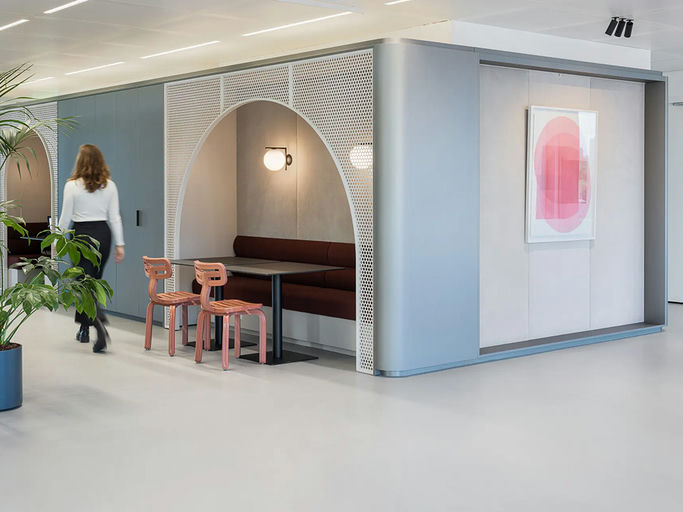 Corques Liquid Lino poured linoleum floorDuracrylCorques Liquid Lino is a seamless linoleum-type floor that is poured on site instead of laid in sheets. Developed by Duracryl in the Netherlands, it is made from linseed oil and resins with wood and cork flour, limestone, cork and natural pigments, and sets overnight at room temperature without adhesive.Image: Duracryl
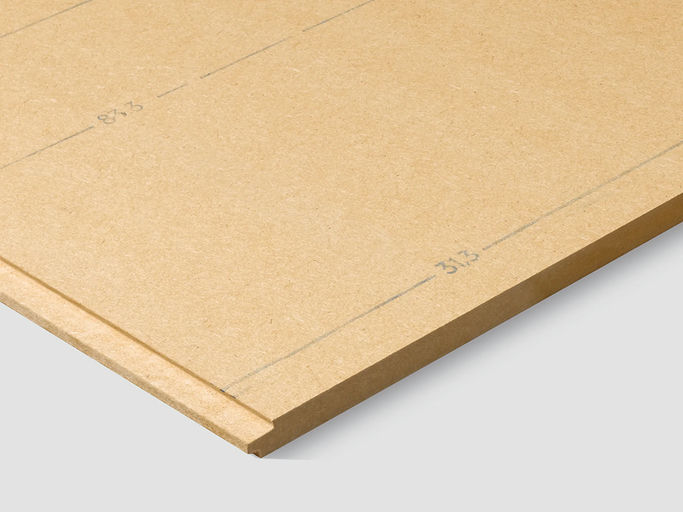 DHF vapour-permeable sheathing board by EggerEGGERDHF is a medium-density wood fibreboard from the Austrian manufacturer Egger, used as a vapour-permeable sheathing panel on the outside of timber-frame walls and as a roof underlay board, where it braces the frame while letting moisture escape.Image: EGGER
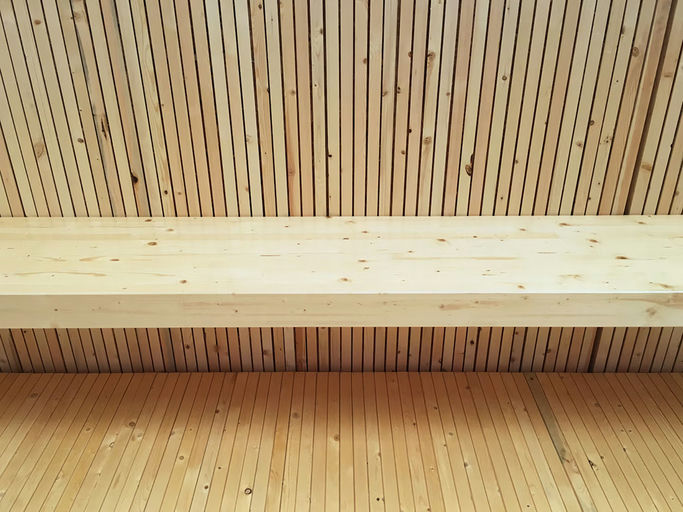 Dowel laminated timber (DLT) by StructureCraftStructureCraftDowel laminated timber (DLT), also known as Brettstapel, is a mass timber panel made of softwood boards stacked on edge and held together by friction-fit hardwood dowels instead of glue or nails.Image: StructureCraft
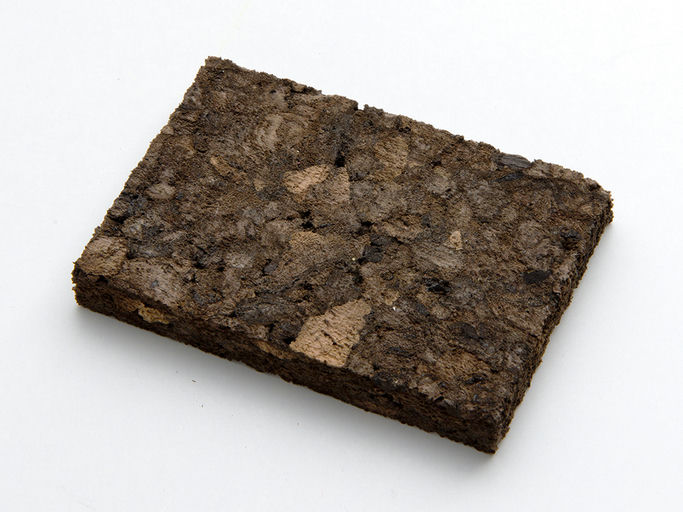 Amorim expanded corkAmorimAmorim expanded cork is used as a natural insulation in roofs, walls, floors, internal partitions and ceilings. It is made up of 100% cork, manufactured from scraps bound together with suberin (a waxy substance found in the cork cell walls).Image: Amorim
Specifying wood well
A short checklist:
- Use certified wood (FSC or PEFC) and know the country of harvest.
- Use the least processed product that does the job: solid before boards, boards before composites.
- Choose engineered timber to replace steel and concrete, not other timber.
- Ask for NAF or ULEF boards and low-VOC finishes indoors.
- Prefer modified timber to tropical hardwood or preservative-treated wood outdoors.
- Design for long life, repair and disassembly; avoid coatings that stop reuse.
Then test a real part in the Material checker.