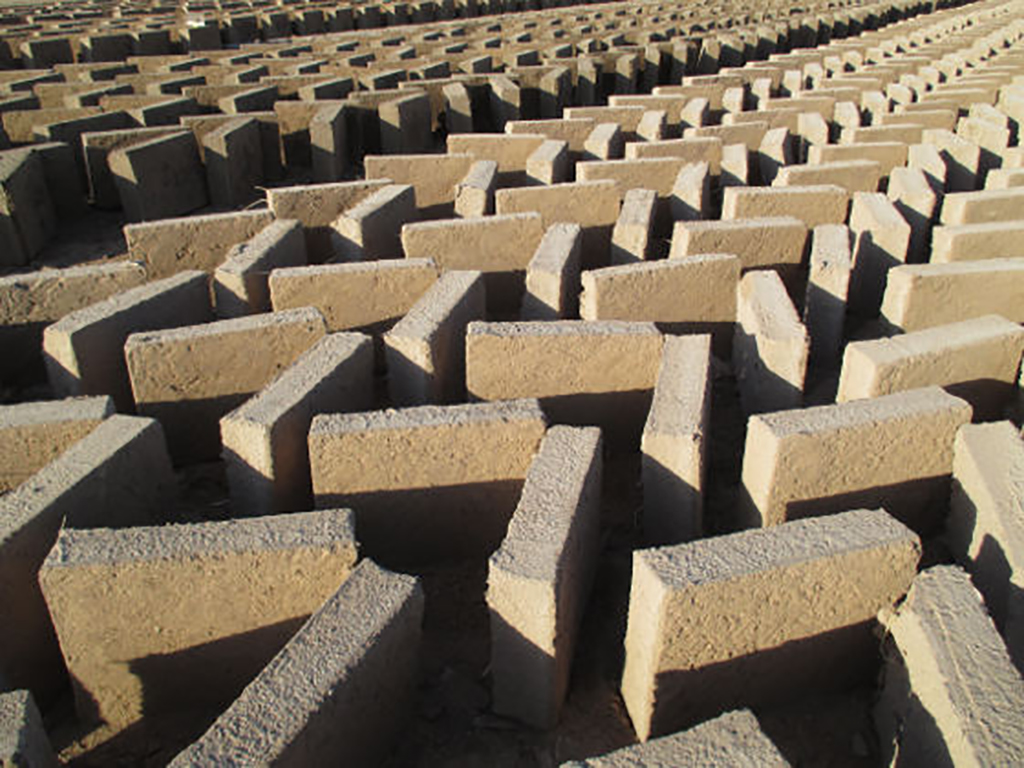
Photo: Sun-dried adobe blocks: soil, water and straw, moulded and left to dry in the sun rather than fired in a kiln. Image: New Mexico Earth.
In short
Most of a material's footprint comes from the energy used to make it: electricity for smelting and electrolysis, high-temperature heat for kilns and furnaces. Swap that energy for sunshine and the numbers can fall dramatically.
The trend is real but uneven:
- Solar electricity is already making materials at scale. Emirates Global Aluminium sold 109,000 tonnes of its solar aluminium in 2025.
- Solar heat for cement and lime has been proven at pilot scale, but no solar cement plant is running commercially.
- Sunlight itself has always dried earth blocks, timber and salt, with no fuel at all.
The catch: a sunny country is not the same as a clean grid, and most "solar" claims rest on certificates rather than a cable from the panels to the factory.
Sources: EGA low-carbon sales 2025 (Aluminium Today) · Synhelion and Cemex solar clinker
Three ways the sun makes materials
1. Solar electricity. Photovoltaic power runs electrolysis and electric furnaces. It matters most where electricity is the main input: primary aluminium, silicon, electric-arc steel and green hydrogen for steelmaking.
2. Solar heat. Mirrors concentrate sunlight onto a receiver to make process heat, in principle hot enough for cement clinker at around 1,500°C. Electric heat batteries can also store solar power as heat for use around the clock.
3. Sunlight direct. No conversion at all: earth blocks dried in the sun instead of fired, timber seasoned in solar kilns, sea salt evaporated in open ponds. And every bio-based material starts with photosynthesis.
The first route is commercial now, the second is mostly pilots, and the third is ancient but easy to overlook.
Sunshine is not a clean grid
Many of the sunniest countries still run their grids mostly on coal and gas. A factory in the Gulf, India, South Africa or Australia that simply plugs in uses some of the most carbon-intensive electricity in the world, while hydro- and nuclear-heavy Norway and France are among the cleanest despite their weather.
So "made in a sunny place" tells you nothing. What matters is whether the factory has its own solar supply, a contract with a specific solar plant, or only certificates bought against the average grid.
Grid electricity: kg CO₂e per kWh
Average grid electricity, lifecycle basis (Ember), 2024–2025 data. A factory buying renewable power can be far lower than its country’s grid.
Solar aluminium: the leading case
Smelting aluminium takes so much electricity that the power source decides the footprint. Metal from a coal-powered smelter is 20 kg CO₂e/kg; low-carbon primary made with hydro or solar power is 3.5 kg CO₂e/kg; recycled aluminium is lower still at 1.35 kg CO₂e/kg.
Emirates Global Aluminium's CelestiAL, made in the UAE with solar power, is the best-known solar example. DNV verified about 5.0 kg CO₂e per kg of ingot for 2025 production, cradle to gate: about a third of the typical global figure, but above hydro-powered metal, because refining alumina and making carbon anodes still emit. BMW was the first customer in 2021. In 2025 EGA sold 109,000 tonnes of CelestiAL, including 36,000 tonnes of CelestiAL-R with recycled metal, out of 2.83 million tonnes in total.
The solar power reaches the smelters through the grid and is tracked with renewable energy certificates.
Where the power comes from changes everything (kg CO₂e per kg)
Sources: EGA CelestiAL carbon footprint verification, DNV (July 2026) · EGA low-carbon sales 2025 (Aluminium Today) · CelestiAL-R and certificates (The National) · Solar tracking by certificates (pv Europe)
Solar heat for cement: proven, not yet commercial
Cement clinker is fired at around 1,500°C, usually with coal, gas or waste fuels. Concentrated solar heat can in principle replace that fuel, though not the CO₂ released from the limestone itself.
- Synhelion and Cemex reported in August 2023 that they had made clinker continuously using only solar heat, with a receiver delivering heat above 1,500°C. Synhelion's DAWN plant in Jülich, Germany, opened in 2024, but it makes synthetic fuels, and the company's 2026 news is all about fuels; there has been no public update on solar cement since.
- Heliogen claimed temperatures above 1,000°C in 2019 and pitched its mirrors for cement and steel. It never reached commercial cement production and was absorbed by the residential solar installer Zeo Energy in August 2025.
For now, a lower-carbon cement means a lower clinker content, such as low-carbon cement at 0.42 kg CO₂e/kg, rather than solar firing.
Sources: Synhelion and Cemex, 2023 · DAWN plant opens (The Chemical Engineer) · Synhelion news 2026 · Heliogen's 2019 claim (GeekWire) · Zeo Energy completes Heliogen acquisition (pv magazine)
Bottling the sun as heat
The sun sets; kilns and boilers need heat around the clock. Heat batteries bridge the gap: cheap daytime solar electricity heats a stack of refractory bricks to well over 1,000°C, and air blown through the stack delivers hot air or steam day and night.
- Rondo Energy started commercial operation of a 100 MWh heat battery in California in October 2025, charged from an on-site solar array and supplying steam alongside existing gas boilers.
- In Thailand, a 33 MWh Rondo battery charged by the grid and a nearby floating solar farm supplies steam to a cement plant's turbine.
An honest note: the first big Californian unit makes steam for an oil producer. The technology is promising for materials, but most installations so far raise steam rather than fire kilns.
Sources: Rondo 100 MWh heat battery (Energy-Storage.news) · Thailand cement plant heat battery (Reccessary)
Dried by the sun
The oldest solar material is earth. Sun-dried earth blocks come in at 0.07 kg CO₂e/kg and rammed earth at 0.018 kg CO₂e/kg, against 0.22 kg CO₂e/kg for fired clay block and 0.12 kg CO₂e/kg for concrete. Unfired earth needs a dry climate or protection from rain, and some blocks add a stabiliser such as cement or asphalt emulsion, which raises the footprint and makes them harder to return to the ground.
The sun dries other materials too:
- Timber: solar kilns dry wood faster than open air drying, to a lower moisture content and with less damage, at a lower energy cost than conventional kilns.
- Salt: solar sea salt is made by letting seawater evaporate in open basins under sun and wind. It is about 10% of the salt produced in Europe, mainly in France, Greece, Italy and Spain.
Unfired earth against fired and cement-based walling (kg CO₂e per kg)
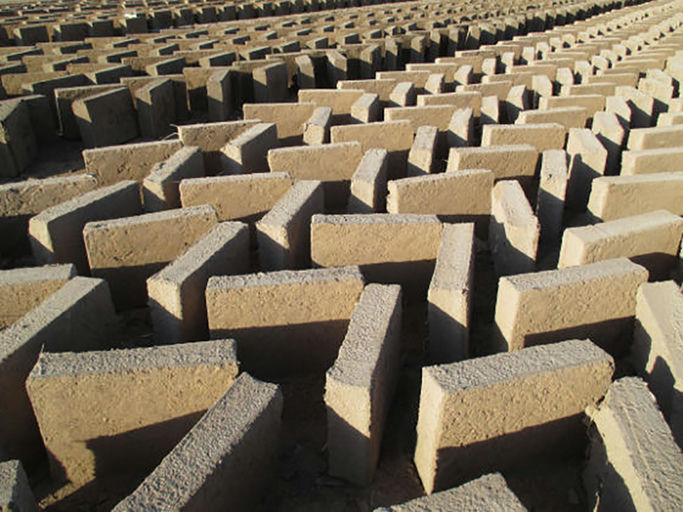 Adobe earth building blocks by New Mexico EarthNew Mexico EarthNew Mexico Earth has made sun-dried adobe blocks in New Mexico, USA, since 1972. The blocks are made from screened local soil, water and straw, moulded and dried in the sun rather than fired.Image: New Mexico EarthTapialblock unfired earth blocks by FetdeterraFetdeterraTapialblock is a prefabricated block of compacted earth, a factory-made version of traditional Spanish rammed earth (tapial), developed by Fetdeterra in Catalonia, Spain, with architect Maite Sainz de la Maza and geologist Macari de Torres.
Sources: Solar evaporation (EuSalt) · Improvements in solar dry kiln design (US Forest Products Laboratory)
The ugly: certificates, night-time and the panels themselves
- Certificates, not cables. Most solar claims are market-based: the factory buys certificates for solar power fed into the grid somewhere else, often matched over a whole year. The GHG Protocol is revising its rules to add hourly and geographic matching for clean energy claims; finalised key requirements were expected from mid-2026 and the full standard by the end of 2027.
- Night-time. Smelters and kilns run 24 hours a day; the sun does not. Without storage, a "solar" plant still draws grid power after dark.
- The panels' own footprint. Solar panels start as metallurgical silicon (10.5 kg CO₂e/kg), refined into electronics-grade silicon (135 kg CO₂e/kg), much of it made with coal-heavy electricity.
- Forced labour. Researchers at Sheffield Hallam University estimated that Xinjiang made 35% of the world's polysilicon in 2022. The EU's ban on products made with forced labour applies from December 2027.
Sources: GHG Protocol Scope 2 revision · Xinjiang polysilicon and forced labour (PV Tech)
Rules and claims
From 27 September 2026 the EU's Empowering Consumers Directive bans generic claims such as "green" or "eco-friendly" without recognised proof, and product claims of climate neutrality based on offsets. A specific claim such as "smelted with solar power" is still allowed, but it must be true and backed by evidence.
For metals, CBAM now prices the embedded emissions of imported aluminium and steel, so ask for the figure a supplier reports there as well as its marketing figure. Certification and declarations that help:
What to ask, and how to choose
Questions for any supplier making a solar claim:
- Is the solar power on site, from a named plant under contract, or bought as certificates?
- Is it matched hour by hour, or only over the year?
- What is the verified footprint per kg, and who checked it?
- Which steps does the solar power cover: smelting only, or refining and casting too?
- Where does the silicon in any panels or equipment come from?
Then weigh the options. Recycled metal often beats any primary metal, solar or not. For walls and finishes, unfired earth and lime can beat fired or cement-based products by a wide margin, wherever the factory is.