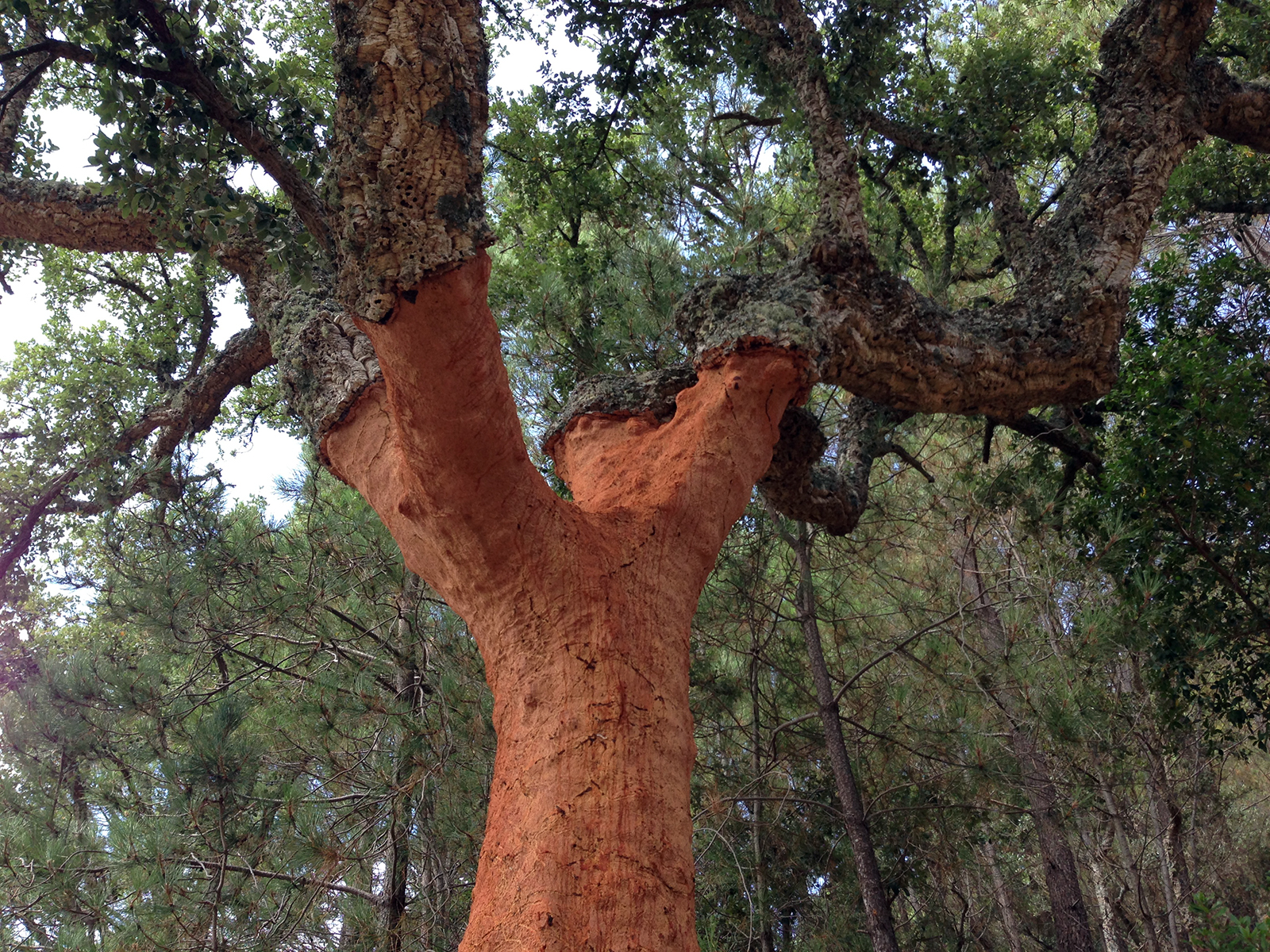
Photo: Cork oaks in Portugal, where it is illegal to cut the trees down and the bark is harvested by hand.
In short
Every log arrives at the mill wearing a coat. Bark makes up about a tenth of a log's volume, and at most sawmills and pulp mills it is stripped off and burned for heat.
That is a modest use for a remarkable material. Bark is what keeps a tree dry, insulated, and defended against fire, insects and fungus.
The trend, in three parts:
- Cork is the one bark with a real industry, and it is spreading from bottle stoppers into insulation, floors, facades and furniture.
- Bark cloth, an ancient textile beaten from fig bark, is being picked up by designers for interiors and fashion.
- Mill bark from spruce, pine and birch is being tested as board, insulation, glue and even rubber. Most of this is still research or start-up scale.
Sources: Södra, Bark · eXtension, Wood processing residues
What bark does for a tree
Bark has two layers, and they suggest different uses.
Outer bark is dead, corky tissue: millions of tiny closed cells filled with air, their walls waterproofed by a waxy substance called suberin. It is light, springy, slow to burn, and it keeps out water and cold. Cork oak grows this layer unusually thick, which is all that cork is.
Inner bark is the living layer that carries sugars down the tree. It is fibrous and strong, which is why it can be beaten into cloth or twisted into rope.
Bark is also the tree's chemical defence. It is rich in tannins, which stop microbes and have been used for thousands of years to turn hides into leather, and in resins and waxes.
So bark offers four things a designer might want: insulation, water resistance, fibre and natural chemistry. Wood offers none of them as well.
Cork: the bark that has an industry
Cork is the outer bark of the cork oak, which grows around the western Mediterranean, above all in Portugal. The tree is not felled. Its bark is cut away by hand for the first time when the tree is about 25 years old and then roughly every nine years, and a tree can live for around 200 years.
Natural cork is 0.5 kg CO₂e/kg. The best bark is punched into wine stoppers; everything else, including the offcuts, is granulated and made into other products.
Expanded cork board (0.7 kg CO₂e/kg) is the purest of them. Granules are heated with steam in a closed mould; they swell and their own resin glues them together, with nothing added. The dark, toasted boards insulate, resist rot and damp, and are now used as exposed facades as well as hidden insulation.
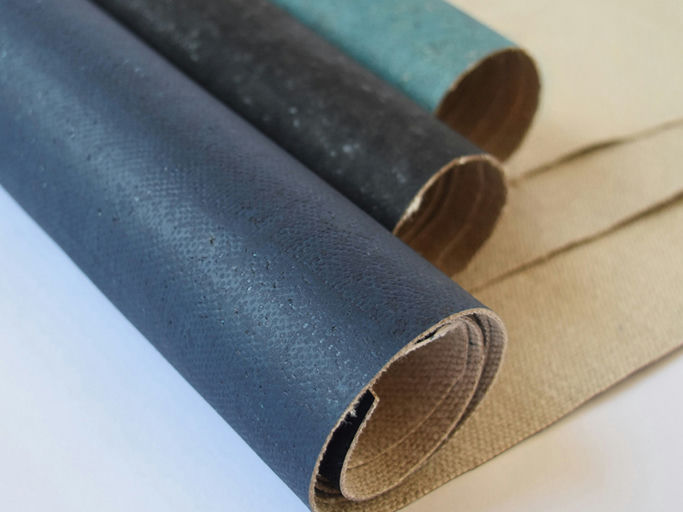
Other cork products are granules held by a binder: floor tiles, underlays, pinboards and rubberised cork (1.5 kg CO₂e/kg). The binder is what to ask about.
Cork products beside the plastics they can replace (kg CO₂e per kg)
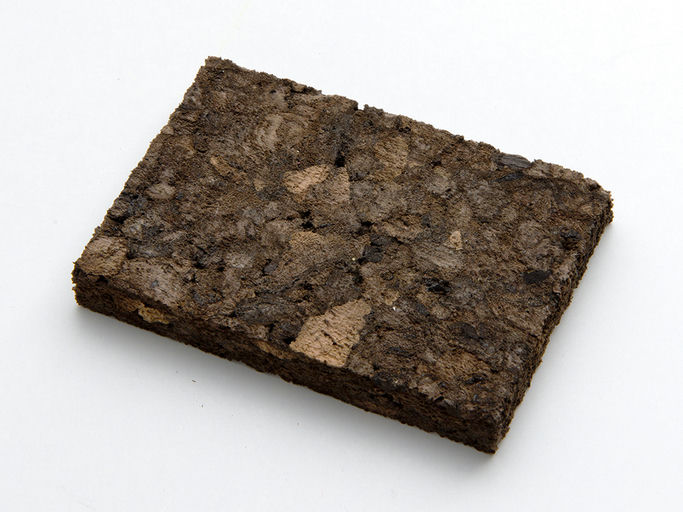 Amorim expanded corkAmorimAmorim expanded cork is used as a natural insulation in roofs, walls, floors, internal partitions and ceilings. It is made up of 100% cork, manufactured from scraps bound together with suberin (a waxy substance found in the cork cell walls).Image: Amorim
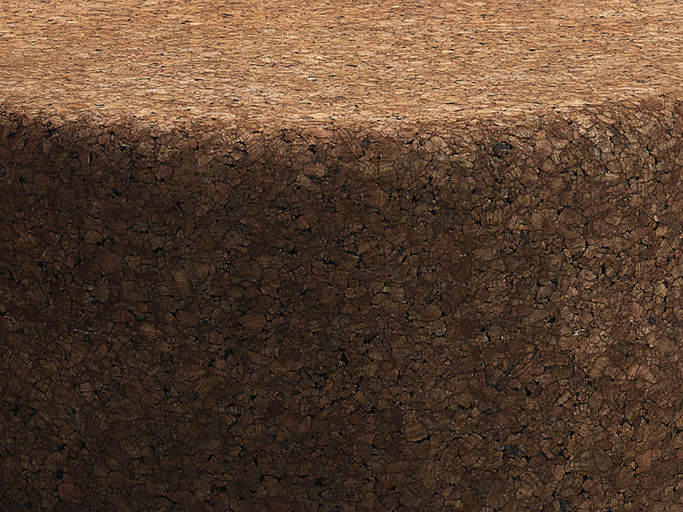 Black cork by SofalcaSofalcaBlack cork by Sofalca, also known as insulation cork board (ICB), consists of 100% cork agglomerate that has been expanded in an autoclave to form a solid block bonded together with the natural resins present in the cork. Sofalca also granulates its own production waste into loose-fill insulation. Image Sofalca.Image: SofalcaThermacork decorative expanded cork wall panels by Amorim Cork InsulationAmorim Cork InsulationAmorim Cork Insulation (formerly Amorim Isolamentos), part of the Portuguese cork group Amorim, makes decorative versions of its Thermacork expanded cork board for exposed interior and exterior wall cladding, such as the MD Facade board and the WAVE collection with a machined relief surface.
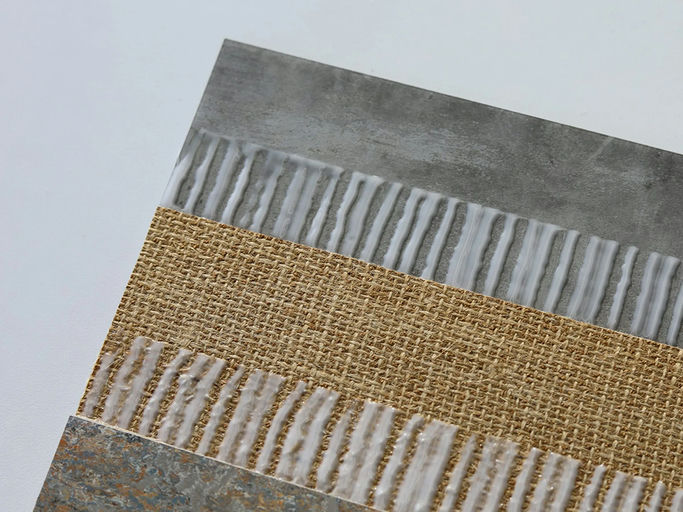 Corkment cork and linseed acoustic underlay by ForboForboCorkment is a 2 mm acoustic underlay from Forbo for its Marmoleum linoleum floors. It is made like linoleum: cork granules, oxidised linseed oil, resins and other ingredients are calendered onto a jute backing and cured.Image: Forbo
Sources: ArchDaily, Could cork be nature's answer? · JSTOR Daily, Putting a cork in it (in construction, that is)
Bark cloth: a textile that is not woven
Bark cloth is made by peeling the inner bark from a fig tree, the mutuba, and beating it with wooden mallets until it spreads into a soft, felt-like sheet several times its original width. There is no spinning and no weaving. The Baganda people of southern Uganda have made it for some seven hundred years, and UNESCO lists the craft as intangible cultural heritage.
The tree is wrapped after harvest and grows its bark back, so the same tree can be harvested again and again over decades.
The cloth is a warm terracotta brown, irregular, and stronger along the grain than across it. Designers are using it for wall coverings, lampshades, bags and upholstery panels, often laminated to a backing. Researchers in Uganda have also tested it layered with glass fibre as a lightweight panel for car interiors.
What to keep in mind: it is a handmade material from a small number of farmers, every sheet differs, and there is no carbon figure for it yet. Buying it fairly matters as much as specifying it.
Sources: Manchester Metropolitan University, Ugandan bark cloth for craft-based fashion · MaterialDistrict, Lubugo: Ugandan barkcloth · Busitema University, Bark cloth tested for car interiors
Mill bark: boards and insulation
The large, untapped supply is the bark of ordinary timber trees: spruce, pine, larch, birch, oak. Mills produce it by the million tonnes, wet and mixed with grit, and burn most of it.
Researchers are finding better uses.
- Pressed bark panels with no glue. A team at the Max Planck Institute peeled bark in large pieces from several species, stacked two layers and hot-pressed them. The bark's own chemistry held the panels together, with nothing added.
- Bark insulation boards. Bark particles pressed at low density make boards that insulate and store heat well, and bark has been shown to take up formaldehyde from the air.
- Bark as cladding and shingles. Whole sheets of poplar and birch bark, flattened and dried, are a traditional facade and roofing material in North America and Scandinavia.
The obstacles are practical. Bark varies by species, season and age; it must be peeled carefully and dried quickly; and burning it is the easy option, since mills need the heat. Treat most of this as promising, not yet purchasable.
Sources: Wenig et al., Adhesives free bark panels (PLOS ONE)
Bark chemistry: tannin, glue and rubber
Some of bark's value is in what can be extracted from it.
- Tannins for leather. Oak, chestnut, mimosa and quebracho bark and wood are the source of vegetable tanning, the oldest way of making leather. Vegetable-tanned leather is still tanned this way.
- Tannins for glue. Bark tannins react much as the phenol in synthetic resins does, and can replace part or all of it in adhesives for particleboard and plywood, and in rigid tannin foams. This matters now that the EU has tightened limits on formaldehyde released by boards.
- Birch bark. Its white outer layer is rich in suberin and in betulin, a waxy compound that makes it waterproof and rot-resistant. People have made containers, roofing and adhesive tar from it since prehistory; a Swedish start-up now makes a rubber from it.
These uses take the chemistry and leave the fibre, which can still be burned or pressed into board afterwards.
The catches
- The binder. Apart from expanded board, most cork products are granules glued together, typically with polyurethane. The same goes for cork fabric, which is a thin cork veneer on a textile backing. A small share of plastic binder changes what can be claimed and what happens at the end of life. Ask what holds it together.
- The coating. Cork floors usually carry a plastic wear layer. Oiled or waxed finishes keep the material repairable.
- Supply. Cork grows slowly in one region, and each tree gives a harvest only every nine years. It cannot scale the way a plastic foam can, and cork forests face drought and fire.
- Burning is not waste. Mill bark already replaces fossil fuel for drying timber. Turning it into products only helps if the heat then comes from something clean.
- Evidence. Cork has EPDs. Bark cloth and pressed bark boards mostly do not, so there are no carbon figures to compare yet.
- Big climate claims. Statements that cork is "carbon negative" count carbon stored in the forest, by methods that differ from one source to the next. Use the product's own declared figure.
Sources: Healthy Materials Lab, Regenerative and biogenic: cork
Where bark fits
- Insulation and facades: expanded cork board, in place of plastic foam, where its cost and thickness are acceptable.
- Floors, underlays, pinboards: cork with a plant-based or no binder and an oil finish, in place of vinyl.
- Wall coverings and accessories: bark cloth, bought from a traceable source.
- Leather: vegetable tanning with bark tannins.
- Boards: ask panel suppliers about tannin-based and other formaldehyde-free binders.
Questions to ask: which tree, and was it felled or harvested standing? What is the binder and the finish? Is there an EPD? Is the forest certified by FSC or PEFC?